
Jun 16, 2026
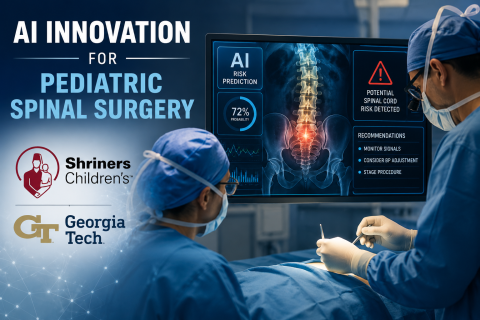
Shriners Children’s and Georgia Tech are collaborating on the development of a new artificial intelligence tool designed to help clinicians better predict and respond to potential risks during pediatric spinal surgery.
Shriners Children’s and Georgia Tech are working together to research and develop a new artificial intelligence tool aimed at supporting physicians during complex pediatric spinal surgeries. The project reflects a growing effort to use data-driven innovation to improve surgical decision-making, reduce risk, and advance care for children with challenging orthopedic and neuromuscular conditions.
The AI tool is being designed to help doctors better anticipate potentially dangerous changes that can occur in the spinal cord during surgery. By analyzing large amounts of clinical and surgical data, the technology could provide clinicians with additional insight as they make critical decisions in real time.
Leanne West, Georgia Tech’s chief engineer of pediatric technology, described the tool as predictive technology that could help care teams better understand what may happen during a procedure before complications occur.
“In this situation, AI is definitely your friend,” West said. “It’s predictive and meant to help understand what might happen during surgery, so you can prevent anything bad from happening.”
The tool will use thousands of data points from surgical procedures, clinical notes, X-rays, patient histories, and other sources of information. By identifying patterns across many patients, the AI system may be able to detect risk factors or warning signs that could otherwise be difficult to recognize during the fast-moving environment of surgery.
Dr. Bruce Brenn, chief of anesthesiology at Shriners Children’s Philadelphia and the lead researcher on the project, said the goal is to create a system that functions like an early warning tool for physicians.
“We’re trying to avoid those things from happening — it’s kind of like a warning system,” Brenn said.
During pediatric spinal surgery, physicians and clinical teams must closely monitor changes in the spinal cord and surrounding systems. The AI tool could help care teams determine when intervention may be needed, such as adjusting blood pressure, changing the surgical approach, or deciding whether a procedure should be completed in stages rather than all at once.
Rather than relying only on the experience of one surgeon or a small group of clinicians, the tool is being developed to draw from a much broader set of patient data. This approach allows researchers to look across many cases and identify trends that could support safer, more informed decision-making.
“What we’re trying to do is use data from a lot of different patients to give us information, as opposed to just one surgeon or a few surgeons’ experience,” Brenn said.
For West, this is where artificial intelligence can be especially valuable in pediatric healthcare. AI can help process complex information, recognize patterns, and identify trends that humans may miss when working with large volumes of data.
“One of the things that AI is really good at is seeing trends, number crunching, and figuring things out that we might miss,” West said.
Although the tool is still in development, the potential impact is significant. Once fully developed and implemented, it could help reduce the risk of injury during surgery, support better outcomes for patients and families, and give clinicians greater confidence as they make high-stakes decisions.
“If you can prevent negative things from happening during a procedure, that’s always a win,” West said. “And I think that additionally, it maybe even helps the clinicians feel more confident in what they’re doing.”
The project also highlights the strength of the ongoing partnership between Shriners Children’s and Georgia Tech. Together, the organizations are working to bring engineering, clinical expertise, data science, and pediatric research into closer alignment to solve complex healthcare challenges.
This collaboration comes as Shriners Children’s prepares to expand its research presence in Atlanta through a new Shriners Children’s Research Institute in partnership with Georgia Tech. The institute is expected to support multidisciplinary research in areas such as artificial intelligence, robotics, medical devices, data informatics, biologics, and other fields that can advance pediatric care.
Through projects like this AI-powered surgical support tool, Shriners Children’s and Georgia Tech are continuing to demonstrate how technology, research, and clinical expertise can come together to improve the future of pediatric medicine.