
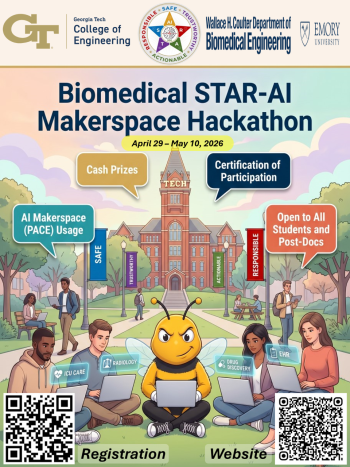
The 2026 Biomedical STAR-AI Makerspace Hackathon is an inaugural, co-sponsored event by the Georgia Tech College of Engineering and the Wallace H. Coulter Department of Biomedical Engineering. Designed to empower the next generation of AI engineers and scientists, this hackathon focuses on applying experiential learning and problem-solving to create real-world impact in healthcare.
As artificial intelligence continues to transform healthcare, there is an increasing need for solutions that are Safe, Trustworthy, Actionable, and Responsible (STAR-AI). This hackathon challenges participants to take on that responsibility—asking a simple but powerful question: Can you build a meaningful AI solution in just 48 hours?
Participants will have access to an AI Makerspace environment from April 29 through May 10, 2026, providing the tools, data, and resources needed to develop their solutions. Teams of up to five members can be formed, and each team may select up to two challenge areas from four real-world biomedical AI problems:
- Multi-Agent Multimodal Retrieval-Augmented Generation (RAG) for Radiology Decision Support
- Robust Drug-Target Affinity Modeling for Precision Drug Discovery
- Safe Clinical Reasoning Agents for EHR-Based Diagnosis
- ICU Multi-Outcome Alarm Systems for Critical Care Monitoring
Each team is required to submit a technical report and a research poster by May 9, 2026 at 11:59 PM EST. Submissions will be evaluated by a panel of both academic and industry experts, ensuring a well-rounded assessment of innovation, technical rigor, and real-world applicability.
The hackathon culminates on May 12, 2026, at the Parker H. Petit Institute for Bioengineering and Biosciences at Georgia Tech (Suddath Seminar Room 1128, 315 Ferst Dr NW, Atlanta, GA). All participating teams will present their work through poster sessions, with select teams chosen to deliver oral presentations. In addition to the competition, the event will feature discussions on AI megatrends and the future of AI education, creating a broader platform for learning and engagement.
Winning teams will have the opportunity to take their work even further, with invitations to publish their results at peer-reviewed AI conferences—offering visibility and recognition within the global scientific community.
This hackathon represents a unique opportunity for students and post-docs to collaborate, innovate, and apply their skills to meaningful healthcare challenges—bridging the gap between theory and real-world impact through hands-on experience.